

Paducah Nursing Home Abuse and Neglect Lawyer
I have actually tried a nursing-home neglect case to a jury in Paducah.
Before that trial, I spent approximately two weeks in Paducah investigating the case, talking with witnesses, preparing testimony, and trying to understand what had actually been happening inside the nursing home.
By the time we went to trial, seven or eight former members of the nursing staff testified about the facility generally and about Cecil Gary’s care specifically.
The jury ultimately returned a $28.55 million verdict.
But the number alone does not explain why that case still influences the way I investigate nursing-home cases today.
Mr. Gary was a large man who had suffered a major stroke. He was paralyzed on one side, had difficulty swallowing, had undergone a leg amputation, and depended heavily on nursing-home staff for basic care.
He required two-person assistance for bed mobility and care.
During hygiene care, a nursing assistant went into his room by herself.
She tried to turn and clean him without the second caregiver his condition required.
Mr. Gary was dropped out of the bed.
He suffered painful fractures.
The question at trial was not simply:
Why did the caregiver drop him?
The bigger question was:
Why was a resident who required two caregivers being cared for by only one?
That question took us beyond the bedside.
It took us into staffing.
Management.
Corporate decisions.
Labor budgets.
And whether the people responsible for staffing the building had given the caregivers enough help to safely provide the care residents required.
That is the kind of investigation Ross Mann Nursing Home and Medical Negligence Lawyers brings to serious nursing-home cases in Paducah and throughout Kentucky.
If someone you love has been seriously injured or has died after suspected nursing-home neglect, call (859) 413-3900 for a free consultation.
The Cecil Gary Case: When a Staffing Decision Reaches the Bedside
One of the most important things I learned from the Gary case is that nursing-home neglect can look very different from the way people imagine it.
Sometimes there is no employee who wakes up intending to hurt someone.
Sometimes there is a resident who needs two people.
And only one person is available.
Mr. Gary required assistance from at least two caregivers for bed mobility.
But evidence presented at trial showed that, between October 2013 and February 2014, his bed mobility was provided by only one caregiver on more than 130 occasions. Public reporting from the trial likewise described evidence that the facility was understaffed while labor costs were being controlled.
On the occasion when he was dropped, a nursing assistant was trying to perform hygiene care by herself.
Our case was not simply that the aide should have known better.
Our evidence was that she had been placed in a situation where Mr. Gary needed care, he required two people to provide it safely, and the second set of hands was not there.
If she waited for another caregiver, the hygiene care might not get done.
So she tried to do it herself.
And Mr. Gary paid the price.
That is what understaffing can look like in real life.
It does not necessarily appear in the chart as:
Corporate management reduced staffing and injured a resident.
It looks like this:
Two people are required.
One person is available.
The resident still needs to be cleaned, turned, toileted, fed, repositioned, or transferred.
The employee tries to get the work done.
Something goes wrong.
That is why we do not automatically stop a nursing-home investigation with the employee who happened to be standing beside the bed.
We ask why that employee was alone.
Seven or Eight Former Nursing Staff Members Testified
Before the Gary trial, I spent approximately two weeks in Paducah.
A substantial part of that work involved finding and talking with people who knew the facility.
Ultimately, seven or eight former members of the nursing staff testified at trial.
They could tell the jury things that a chart could not.
They could explain:
- what the facility was actually like to work in;
- how resident assignments worked;
- whether staffing shortages occurred;
- whether employees had enough time to provide required care;
- what happened when someone called off;
- whether care was routinely rushed;
- whether employees could realistically carry out every resident’s care plan;
- how management responded to staffing problems;
- what staff knew about Mr. Gary;
- and what they personally observed about his care.
That testimony helped put the records into context.
A staffing spreadsheet can tell you how many hours were reported.
A former nurse or aide may be able to tell you what those numbers actually meant inside the building at 7:00 on a Saturday night.
Here is what some of that testimony was:
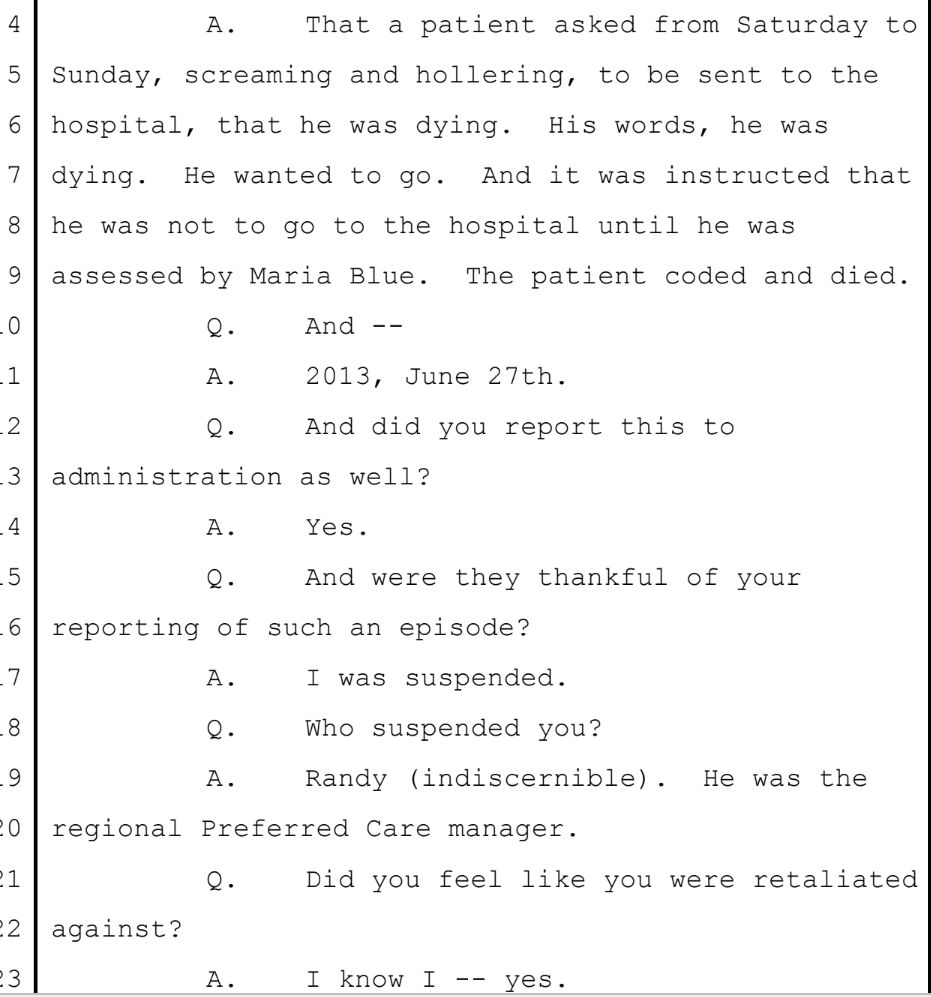
That is one reason we look for witnesses.
We Do Not Investigate Nursing Home Cases Only From Behind a Desk
Medical records matter.
So do witnesses.
So do staffing records.
So do corporate documents.
A serious nursing-home case may require putting all of those pieces together.
Depending on what happened, we may investigate:
- Minimum Data Set (MDS) assessments;
- resident care plans;
- nursing notes;
- CNA documentation;
- medication administration records;
- treatment records;
- wound records;
- photographs;
- fall-risk assessments;
- transfer status;
- mobility requirements;
- dietary records;
- hydration records;
- physician orders;
- hospital records;
- EMS records;
- incident reports;
- internal facility investigations;
- employee schedules;
- employee time records;
- employee assignments;
- Payroll-Based Journal staffing data;
- agency staffing;
- facility policies;
- state and federal survey records;
- ownership records;
- organizational charts;
- management agreements;
- corporate communications; and
- testimony from current and former employees.
The chart tells us what someone documented.
The rest of the evidence may help explain why it happened.
The Question Is Often Not “Who Made the Mistake?”
That question may be too small.
Suppose an aide fails to reposition a resident.
Why?
Suppose a resident who required two-person assistance is transferred by one person.
Why?
Suppose a resident waits too long for toileting help.
Why?
Suppose fluid intake is not adequately monitored.
Why?
Suppose a nurse does not recognize a significant change in condition quickly enough.
Why?
Sometimes the answer involves an individual employee.
Sometimes it involves training.
Sometimes supervision.
Sometimes the building simply did not have enough people available to provide the care the residents required.
And sometimes those decisions were made higher in the corporate structure.
That is why we ask:
How many employees were scheduled?
How many actually worked?
How many residents were assigned to them?
What care did those residents require?
Who determined staffing?
Who controlled labor spending?
Did management know required care was being missed?
Did anyone complain?
Were the problems recurring?
That is a nursing-home investigation.
Understaffing Must Be Connected to the Resident
I do not believe a useful staffing case simply says:
This nursing home was understaffed.
That is too easy.
The staffing evidence has to be connected to what happened to the resident.
If the resident required two-person assistance, we want to know whether two people were available.
If the resident required feeding assistance, we want to know whether someone had time to sit there and provide it.
If the resident required frequent repositioning, we want to know whether staff could actually perform it.
If the resident had dementia and needed supervision, we want to know whether meaningful supervision was possible.
If the resident was at risk for dehydration, we want to know who was responsible for offering fluids, measuring intake, recognizing declining intake, and responding when the resident deteriorated.
Staffing is not just a number.
Staffing is whether the resident got the care the resident needed.
Mr. Gary’s Case Involved More Than the Fall
The Gary case was not only about being dropped.
Mr. Gary suffered repeated serious problems while in the facility, including dehydration and malnutrition.
Public reporting from the trial described one episode in which he experienced severe abdominal symptoms before being transferred to the hospital. When he ultimately arrived, his condition included shock, acute renal failure, and profound dehydration.
The case also involved failures to keep his sister and guardian informed about important changes in his condition.
That matters because serious nursing-home neglect is rarely understood by looking at one isolated event.
We reconstruct the course of care.
What happened first?
What happened next?
What did staff know?
When did they know it?
What did they do?
What did they fail to do?
Who was notified?
Who was not?
And what happened to the resident because of it?
Dehydration and Malnutrition
Older and medically fragile residents can be at increased risk for dehydration and malnutrition.
That does not mean serious dehydration or unexplained weight loss should automatically be blamed on age.
We may examine:
- fluid-intake records;
- meal consumption;
- weight trends;
- dietary assessments;
- supplements;
- swallowing evaluations;
- laboratory results;
- physician orders;
- nursing records;
- CNA records;
- assistance provided during meals;
- and staffing.
A resident may need someone to offer fluids repeatedly throughout the day.
That requires time.
A resident may require assistance eating.
That requires time.
A resident with swallowing impairment may require specialized supervision.
That requires time.
Again, staffing and resident care frequently intersect.
Falls and Dropped Residents
A dropped-resident case is different from an ordinary unassisted fall.
Residents may require:
- one-person assistance;
- two-person assistance;
- gait belts;
- mechanical lifts;
- sit-to-stand devices;
- or other specified interventions.
The care plan may clearly say what is required.
The harder question is whether the facility actually had the people and equipment available to carry it out.
In Mr. Gary’s case, public trial reporting confirms that at least two people were supposed to assist him, yet he was sometimes provided bed-mobility care by only one caregiver, including when he fell from bed during hygiene care.
That is precisely why we investigate the difference between what the care plan required and what actually happened at the bedside.
Infection, Sepsis, and Delayed Hospital Transfer
Some nursing-home cases become cases about time.
When did the resident begin deteriorating?
When did staff notice?
When was the change documented?
What were the vital signs?
When was a physician contacted?
What did the physician order?
When was the family notified?
When was EMS called?
When did the resident reach the hospital?
Cases involving pneumonia, urinary infections, infected wounds, aspiration, sepsis, or septic shock may require reconstructing hours—or sometimes days—of care.
The timeline matters.
Pressure Injuries and Bedsores
Pressure injuries can raise similar questions about whether planned care was actually delivered.
We may examine:
- skin condition on admission;
- mobility;
- risk assessments;
- nutrition;
- hydration;
- repositioning plans;
- support surfaces;
- skin assessments;
- wound measurements;
- wound photographs;
- treatment orders;
- physician notification;
- and staffing.
The wound itself matters.
But so does everything that happened before it became severe.
Medication Errors
Medication errors may involve:
- the wrong medication;
- the wrong resident;
- an incorrect dose;
- medication administered at the wrong time;
- omitted medication;
- failure to follow a physician order;
- failure to monitor after administration;
- or failure to respond after an error occurs.
When the consequences are serious, we may investigate much more than the Medication Administration Record.
Evidence can include:
- physician orders;
- pharmacy records;
- medication packaging;
- electronic audit data;
- witness testimony;
- staffing;
- facility policies;
- and the facility’s internal investigation.
The person who physically administered the medication may be only one part of the story.
Choking and Aspiration
Residents who have suffered strokes, dementia, neurological disease, weakness, or swallowing impairment may face increased choking and aspiration risk.
The evidence may involve:
- speech-therapy assessments;
- diet consistency;
- physician orders;
- feeding assistance;
- meal supervision;
- positioning;
- staffing;
- and the facility’s emergency response.
The central question remains the same:
What did the facility know about this resident, and did it provide the care the resident required?
Kentucky Nursing Home Residents Have Specific Legal Rights
Kentucky nursing-home cases do not involve only ordinary negligence law.
KRS 216.515 provides long-term-care residents with specific statutory rights involving dignity, abuse, restraints, communication, medical information, grievances, family notification, and other aspects of life in a facility.
Ross Mann has actually tried KRS 216.515 residents’ rights claims to Kentucky juries.
In the Gary case, the jury awarded approximately $1.05 million for violations of Mr. Gary’s residents’ rights, in addition to other compensatory and punitive damages. The publicly reported verdict totaled $28.55 million: $2.5 million for physical pain and mental anguish, $1.05 million for residents’ rights violations, and $25 million in punitive damages.
Read more about Kentucky Nursing Home Residents’ Rights.
Who Was Behind the Facility?
A nursing home may have several different companies behind it.
One company may hold the facility license.
Another may provide management.
Another may own the building.
Another may provide administrative or clinical services.
That matters when the issue involves staffing or operational decisions.
In the Gary litigation, the defendants included corporate entities connected with the ownership, operation, and management of the nursing home. Public reporting identified Preferred Care, Inc., Preferred Care Partners Management Group, and Kentucky Partners Management among the entities involved.
Our goal in a new case is not to sue every company whose name appears on a corporate chart.
Our goal is to determine who actually controlled the decisions that mattered.
Corporate Decisions Can Reach the Bedside
The Gary case is a good example.
Mr. Gary was not injured because an accounting spreadsheet fell on him.
He was injured at the bedside.
But the staffing decisions affecting that bedside may have been made somewhere else.
That is why a serious nursing-home investigation may examine:
- staffing budgets;
- labor targets;
- management agreements;
- corporate policies;
- administrator communications;
- quality reports;
- schedules;
- turnover;
- agency usage;
- overtime;
- staffing complaints;
- and testimony from employees.
The corporate document and the bedside injury may appear worlds apart.
Sometimes they are not.
Why Former Employees Matter
Former employees can be particularly valuable witnesses.
They may be able to discuss facility practices without the same employment pressures faced by someone who still works there.
They may know:
- whether staffing problems were chronic;
- whether management knew about them;
- whether assignments were realistic;
- whether employees complained;
- whether policies were actually followed;
- whether charting matched the care being delivered;
- whether staff routinely worked short;
- and whether the problem existed before the particular resident was injured.
In the Gary case, seven or eight former nursing staff members testified about the facility and Mr. Gary’s care.
That type of investigation takes time.
Which is why I spent roughly two weeks in Paducah before trial doing it.
Paducah and McCracken Circuit Court
When venue is proper in McCracken County, a Paducah nursing-home case may be litigated in McCracken Circuit Court.
McCracken Circuit Court is part of Kentucky’s 2nd Judicial Circuit and currently operates in two Circuit Court divisions. The courthouse is located at 300 Clarence Gaines Street in Paducah.
We have actually tried nursing-home litigation there.
A serious case may involve:
- written discovery;
- extensive medical records;
- staffing records;
- corporate documents;
- depositions of aides and nurses;
- administrators;
- directors of nursing;
- physicians;
- former employees;
- medical experts;
- nursing experts;
- corporate representatives;
- arbitration disputes;
- dispositive motions;
- and ultimately a jury trial.
We prepare cases with that possibility in mind.
Arbitration Agreements in Paducah Nursing Home Cases
Families sometimes discover an arbitration agreement in the admission paperwork.
Do not assume its existence answers the question.
Issues can include:
- who signed it;
- whether that person had authority;
- the source and scope of that authority;
- the wording of the agreement;
- and the circumstances surrounding execution.
We review the actual documents and applicable Kentucky law before deciding what effect an arbitration provision may have.
Nursing Homes in Paducah
Current CMS-derived data identify these Medicare-certified nursing facilities in Paducah:
- Parkview Nursing & Rehabilitation Center
- Providence Pointe Healthcare
- Stonecreek Health and Rehabilitation
- River Haven Nursing and Rehabilitation Center
Current federal/CMS-derived records identify all four as Paducah nursing facilities.
This is a reference list of nursing facilities located in Paducah. Inclusion does not mean that Ross Mann Nursing Home and Medical Negligence Lawyers has represented a client involving the facility, that a claim has been asserted against it, or that the facility has engaged in wrongdoing. We have not represented clients involving every facility listed.
For ratings, inspection reports, staffing information, and other facility data, see our Kentucky Nursing Home Ratings & Inspection Reports resource.
What Should a Family Preserve?
If you believe something serious happened in a nursing home, preserve whatever you already lawfully possess.
That may include:
- photographs;
- videos;
- text messages;
- emails;
- admission paperwork;
- hospital records;
- discharge documents;
- medication lists;
- care-plan documents;
- bills;
- and notes showing what your family observed and when.
Do not alter records.
Do not obtain documents you are not legally entitled to possess.
Preserve what you have.
Other records can be obtained through the appropriate legal process.
How Long Do You Have to Bring a Kentucky Nursing Home Case?
Kentucky has short limitations periods for many nursing-home, negligence, and medical-negligence claims.
There is no responsible way to calculate every deadline from one webpage.
The answer can depend on:
- the type of claim;
- the defendant;
- when the injury occurred;
- when the injury was discovered;
- whether the resident died;
- estate proceedings;
- appointment of a personal representative;
- residents’ rights issues;
- and other circumstances.
Have the actual dates reviewed promptly.
Why Hire Ross Mann for a Paducah Nursing Home Case?
Because Paducah is not a city we found in a keyword report.
I spent weeks there doing the work.
Before the Cecil Gary trial, I spent approximately two weeks in Paducah investigating the case and talking with witnesses.
Seven or eight former nursing staff members ultimately testified about the facility generally and about Mr. Gary’s care specifically.
The case involved a resident who required two people for care being handled by one caregiver.
It involved staffing.
It involved hydration.
It involved delayed treatment.
It involved residents’ rights.
It involved corporate defendants.
And it required putting all of those pieces together for a McCracken County jury.
The jury returned a $28.55 million verdict.
Past results do not guarantee future outcomes.
But there is a difference between saying:
We handle Paducah nursing-home cases.
and being able to say:
We have spent weeks in Paducah investigating one, found the witnesses, tried it to a Paducah jury, and obtained a $28.55 million verdict.
That is experience.
And that experience affects how we investigate the next case.
Frequently Asked Questions About Paducah Nursing Home Cases
Why does the Cecil Gary case matter to another family?
Because the lessons extend beyond one resident.
The case showed why nursing-home investigations sometimes require staffing records, former employees, corporate records, care plans, and evidence outside the medical chart.
Do I need a lawyer whose office is physically located in Paducah?
No.
What matters is whether the lawyer understands Kentucky nursing-home litigation and is prepared to handle the case in the venue where it belongs.
We have actually investigated and tried nursing-home litigation in McCracken County.
Why do former nursing-home employees matter?
They may be able to explain what daily operations were actually like.
They may know about staffing, assignments, supervision, management practices, recurring problems, and the resident’s care.
In the Gary case, seven or eight former nursing staff members testified.
What records matter most?
It depends on the case.
The medical chart matters, but serious cases may also involve:
- MDS assessments;
- care plans;
- staffing records;
- hospital records;
- medication records;
- incident investigations;
- survey records;
- ownership information;
- management agreements;
- corporate documents;
- and witness testimony.
What if an arbitration agreement was signed?
Send us the admission paperwork.
The effect of an arbitration agreement can depend on the agreement itself, who signed it, and what authority that person had.
Does Ross Mann handle cases outside Paducah?
Yes.
Ross Mann Nursing Home and Medical Negligence Lawyers represents families in nursing-home cases throughout Kentucky.
What does it cost?
We handle nursing-home cases on a contingency-fee basis.
There is no attorney fee unless we obtain a recovery.
We explain the fee agreement and responsibility for case expenses before representation begins.
Talk to a Paducah Nursing Home Abuse and Neglect Lawyer
If someone you love suffered a serious fall, was dropped during care, became dehydrated or malnourished, developed a pressure injury, suffered a medication error, experienced choking or aspiration, developed sepsis, wandered from a facility, suffered abuse, or experienced other suspected nursing-home neglect in Paducah, we can investigate what happened.
We start with the resident.
What did this person need?
What did the care plan require?
What actually happened?
Who was supposed to provide the care?
Were enough people available?
What did management know?
Who controlled the decisions?
What do the records show?
What do the witnesses say?
And did failures in care cause or contribute to the injury or death?
Call Ross Mann Nursing Home and Medical Negligence Lawyers at (859) 413-3900 for a free consultation about a Paducah nursing-home case.
Past results do not guarantee future outcomes.
Additional information concerning the Cecil Gary verdict: After the trial, Preferred Care, Preferred Care Partners Management Group, and related entities filed Chapter 11 bankruptcy proceedings in November 2017 in the United States Bankruptcy Court for the Northern District of Texas. The bankruptcy proceedings were separate federal matters. Nothing on this page should be read as stating that the Gary verdict caused those bankruptcy filings. A jury verdict and the amount ultimately recoverable or collected are not necessarily the same.
.